
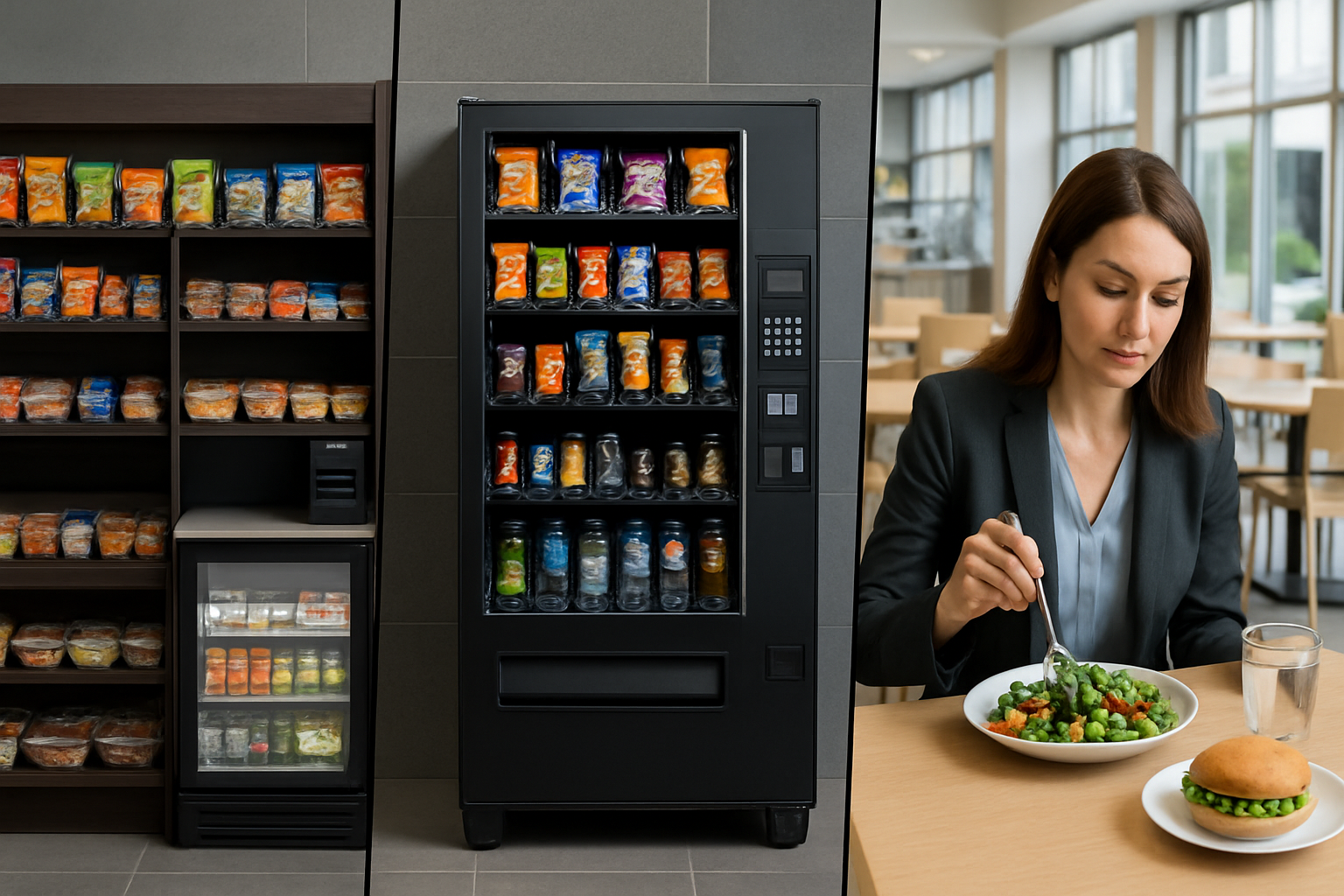
The Breakroom Decision No One Makes Twice Lightly
Choosing how to feed your workforce sounds simple — until you’re three months into a contract that doesn’t fit your building, your headcount, or your budget. Whether you’re a vending operator advising a new client, a facilities manager evaluating options for a growing office, or an HR leader trying to improve the employee experience, the choice between a micro-market, traditional vending machines, and a full cafeteria carries real consequences.
This isn’t a sales pitch for any single model. Each solution has a legitimate place in the market. But understanding where each one excels — and where it falls short — is the only way to make a confident recommendation. Let’s break it down honestly.
Cost Structure: What You’re Actually Paying For
Cost is almost always the first question, and it looks different depending on which side of the transaction you’re on.
Traditional vending machines typically have the lowest barrier to entry. For operators, the capital cost per machine is well-established, and for location hosts, there’s usually no upfront investment at all. The trade-off is that the revenue ceiling is also relatively low, and margins can tighten as technology maintenance and product costs rise.
Full cafeterias sit at the opposite end of the spectrum. Build-out costs, commercial kitchen equipment, health permits, and ongoing labor expenses make cafeterias a significant financial commitment — one that generally only pencils out at high employee densities. Many organizations that once operated company cafeterias have scaled them back precisely because fixed overhead is difficult to justify when utilization fluctuates.
Micro-markets occupy a practical middle ground. Startup costs are higher than a single vending machine but a fraction of cafeteria infrastructure. Because micro-markets operate on a self-checkout model with no dedicated cashier, ongoing labor costs stay low. Operators often find that higher average transaction values and broader product variety make micro-markets more profitable per location than traditional vending routes — though results will vary based on location size and product mix.
Space Requirements: Working With What You Have
Square footage is a non-negotiable constraint in most facilities decisions.
A standard vending machine requires minimal dedicated space — typically just enough floor space for the unit itself plus access clearance. That simplicity is a genuine advantage in smaller offices, warehouses, or facilities where a dedicated breakroom isn’t available.
Cafeterias demand substantial, purpose-built space: kitchen infrastructure, ventilation, seating, and compliance with commercial food-service codes. Retrofitting an existing space to cafeteria standards is costly and disruptive.
Micro-markets are designed to transform an existing breakroom — typically a few hundred square feet — into a curated retail experience. Open shelving, a smart cooler or two, and a self-checkout kiosk can be configured to fit most standard breakroom footprints without major construction. For facilities managers working with a defined but usable space, this flexibility is one of the micro-market’s clearest advantages.
Product Variety and Freshness: Setting Honest Expectations
This is where the three models diverge most visibly — and where employee perception often hinges.
Traditional vending machines are constrained by their mechanical design. Product slots are finite, ambient temperature is fixed (unless it’s a refrigerated unit), and fresh food options are limited by shelf-life logistics. Operators work hard within these constraints, but the format has a ceiling.
Cafeterias, when well-run, offer the widest variety and the freshest food. Hot meals, made-to-order options, and daily specials are genuine differentiators. The catch is that this quality is entirely dependent on staffing — and staffing is where cafeteria models often struggle today.
Micro-markets offer a meaningful step up from vending in both variety and freshness. Open coolers can hold sandwiches, salads, yogurt, and beverages. Ambient shelving supports snacks, packaged meals, and personal care items. Because inventory is managed through real-time software rather than machine slots, operators can rotate product more responsively. The result is a retail-style experience that many employees genuinely prefer over a vending wall — without the overhead of a staffed kitchen.
Staffing: The Hidden Variable
Labor is one of the most underappreciated factors in this comparison.
-
Vending machines: Require route drivers for restocking and maintenance technicians for repairs — but no on-site staff. Labor is managed off-site and scaled across multiple locations.
-
Cafeterias: Require cooks, cashiers, supervisors, and cleaning staff. Scheduling, turnover, and benefit costs add significant complexity that falls on either the employer or a managed food-service contractor.
-
Micro-markets: Operate unattended. A route driver restocks inventory on a scheduled basis — similar to vending — but the self-checkout kiosk handles all transactions. There is no cashier, no cook, and no on-site headcount to manage. For HR and facilities leaders trying to minimize operational complexity, this is a meaningful distinction.
When labor markets are tight, as many operators and facilities managers have experienced in recent years, the self-service nature of a micro-market becomes an operational resilience advantage rather than just a cost-saving feature.
Employee Satisfaction: What People Actually Want
It’s worth naming this directly, because the goal of any breakroom solution is ultimately to serve the people using it.
Cafeterias score highest on satisfaction when they’re well-resourced and well-managed — freshly prepared food and a comfortable dining environment are hard to beat. But when they’re understaffed or underfunded, satisfaction drops quickly, and a declining cafeteria can become an employee relations issue rather than a benefit.
Traditional vending machines meet a functional need reliably. Employees know what to expect, and convenience is the primary value. They don’t generate strong positive sentiment, but they rarely generate strong negative sentiment either — unless machines are frequently out of stock or out of order.
Micro-markets tend to generate noticeably positive reactions, particularly in workplaces that previously had only vending. The open, retail-style layout, broader product selection, and ability to see and choose fresh food before purchasing all contribute to a better user experience. Many operators and location hosts report that micro-markets become a visible, talked-about workplace amenity — the kind of benefit that employees notice and mention.
The Plain-Language Verdict: Which Model Fits Which Workplace?
There’s no single right answer, but the pattern is fairly clear:
Traditional vending machines remain the right call for smaller locations, satellite offices, or facilities where space and foot traffic don’t justify a larger investment. They’re reliable, low-maintenance, and proven. Don’t replace them where they’re working.
Full cafeterias make sense for large campuses — corporate headquarters, major manufacturing facilities, universities — where the employee population is large enough to drive consistent utilization and justify the infrastructure. If your organization has the scale and wants to invest in a premium food experience, a well-run cafeteria is still the gold standard.
Micro-markets are the strongest fit for mid-size workplaces — generally locations with enough daily foot traffic to support a curated product selection — that want to offer a meaningfully better experience than vending without the overhead of a cafeteria. They’re also an increasingly popular upgrade path for operators looking to grow revenue per location and for employers trying to compete on workplace amenities without adding headcount.
Making the Right Call for Your Location
The best breakroom solution is the one that matches your space, your workforce size, your operational capacity, and your budget — not the one with the most impressive features on paper. Getting that match right from the start saves everyone time, money, and frustration.
If you’re evaluating whether a micro-market could be the right fit for one of your locations, Three Square Market’s team can walk you through the specifics — space requirements, product mix, kiosk options, and what operators in similar situations have found works best. Request a proposal today and get a straightforward assessment built around your actual situation.