
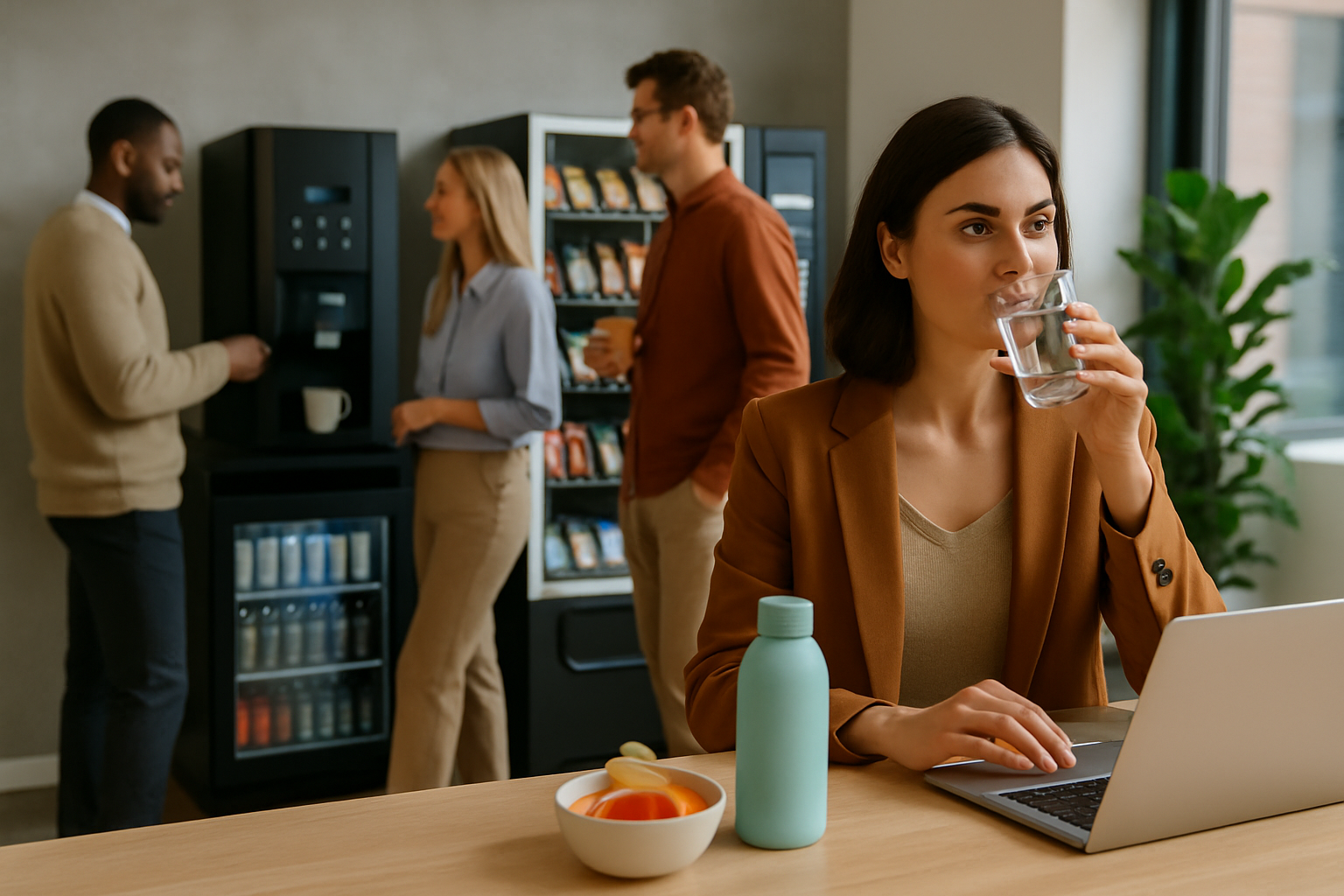
The Breakroom Is Not What It Used to Be
For decades, the workplace breakroom followed a predictable formula: a few vending machines along the wall, fluorescent lighting, and a folding table. It was functional, but rarely anything more. Today, that formula is being rewritten — and the operators, facilities managers, and HR leaders who recognize the shift early will be best positioned to meet the moment.
Four converging trends are reshaping how employees access food and beverages at work: the broader move from traditional vending to unattended retail, the uneven foot traffic created by hybrid work schedules, a genuine and sustained demand for fresh and healthy options, and the near-universal expectation of cashless, frictionless payment. Taken together, these trends don’t point in different directions — they all point toward the same solution.
From Vending Machines to Unattended Retail: A Fundamental Shift
Traditional vending machines are engineering marvels in their own right. They are reliable, low-maintenance, and space-efficient. But they are increasingly at odds with what today’s consumers expect from a point-of-sale experience.
The broader retail industry has spent years normalizing self-checkout, frictionless convenience, and open-format browsing. Grocery stores, airports, and even healthcare facilities have moved in this direction. The workplace is following suit. Employees who shop at self-checkout lanes on the weekend and order through app-based kiosks during lunch are arriving at the office with higher expectations for their breakroom.
Unattended retail — an umbrella category that includes micro-markets, smart coolers, and automated checkout kiosks — addresses that expectation directly. Unlike a vending machine, a micro-market allows consumers to physically pick up a product, examine it, and make a considered purchase. That open, store-like experience meaningfully changes the relationship between the consumer and the product. Many operators find that this format drives broader product engagement and higher average transaction values compared to traditional vending placements.
The shift is not about abandoning vending entirely. It is about understanding that unattended retail is the next chapter — and positioning accordingly.
Hybrid Work Has Complicated Breakroom Math
If the pandemic permanently changed one thing about the American workplace, it is the weekly rhythm of who is in the office and when. Hybrid work schedules — whether two days a week, three, or some rotating arrangement — have introduced a new operational challenge for anyone managing a workplace refreshment program: traffic variability.
A location that draws a full crowd on Tuesday and Thursday may be at 40 percent capacity on Monday and Friday. That variability creates real problems for traditional vending replenishment models, which are typically built around consistent consumption patterns. Overstocking on slow days leads to spoilage; understocking on busy days leads to frustrated employees and lost revenue.
Micro-market technology addresses this problem through smarter inventory management. Cloud-connected software can surface consumption data by day, time, and product category — giving operators the visibility they need to build replenishment schedules that reflect actual demand rather than assumptions. For facilities managers and HR leaders, that translates to a breakroom that feels fully stocked when people need it most, without the waste that comes from a one-size-fits-all approach.
The Demand for Fresh and Healthy Is Not a Fad
The wellness movement in consumer food culture has been building for years, and it has firmly crossed into the workplace. Employees increasingly expect their employer — or their employer’s refreshment provider — to offer options that align with how they actually want to eat.
This does not mean every location needs to become a health food store. It means that a product mix weighted entirely toward shelf-stable snacks and sugary beverages is leaving demand unmet. Fresh salads, grab-and-go protein options, yogurt parfaits, fresh fruit, and better-for-you beverages are no longer premium add-ons. For a growing segment of the workforce, they are the baseline expectation.
Traditional vending machines were never well-suited to fresh food. Temperature control, product visibility, and spoilage management all work against the format. Micro-markets, by contrast, are designed for it. Refrigerated cases allow for proper temperature zones. Open shelving means employees can see and reach fresh items easily. And inventory software helps operators rotate perishable stock efficiently, reducing waste and maintaining quality.
For HR and facilities leaders, a refreshment program that includes fresh options is also a visible signal — one that communicates that the organization takes employee wellbeing seriously.
Cashless Payments Are Now the Baseline Expectation
Cash is not gone, but it is no longer the default. Across virtually every consumer touchpoint — retail, transit, food service, parking — digital and card-based payment has become the expected norm. The workplace breakroom is not exempt from that shift.
Employees who carry no cash, or who simply prefer the convenience of tapping a card or a phone, are not going to change that habit because a vending machine requires quarters. They will skip the purchase — or they will develop a quiet frustration with a breakroom that feels out of step with the rest of their lives.
Modern micro-market kiosks support the full range of payment options that today’s consumers use:
-
Credit and debit cards (chip, swipe, and tap)
-
Mobile wallets (Apple Pay, Google Pay, and similar platforms)
-
Prepaid market accounts and employee badge integrations
-
QR code-based payment flows
For operators, broad payment acceptance is not just a convenience feature — it is a revenue protection measure. Removing friction from the transaction removes the single most common reason a consumer walks away without buying.
Micro-Markets as the Through-Line
Each of the trends described above is significant on its own. What makes this moment particularly meaningful for operators and workplace decision-makers is that they are all happening simultaneously — and a well-deployed micro-market program addresses all four at once.
The open-format experience matches the unattended retail moment. Inventory software adapts to hybrid work traffic patterns. Refrigerated cases support fresh and healthy product mixes. And modern kiosks accept every payment method employees already use. That convergence is not a coincidence. It reflects the fact that micro-market technology was built for exactly the direction the market was always heading.
The Takeaway for Operators and Workplace Leaders
Workplace refreshment is in a period of genuine transition. The operators who will thrive are those who read these trends as strategic signals rather than background noise — and who invest in the infrastructure to meet employees where they already are.
For facilities managers and HR leaders, now is a good time to audit your current breakroom program against these expectations. Is your format aligned with how your workforce wants to shop? Does your product mix reflect what your employees actually want to eat? Can every employee pay the way they prefer?
If any of those answers feel uncertain, a micro-market consultation is a practical next step. Three Square Market works with operators and workplace decision-makers across North America to design refreshment programs that fit the space, the workforce, and the moment. Request a proposal to start the conversation.